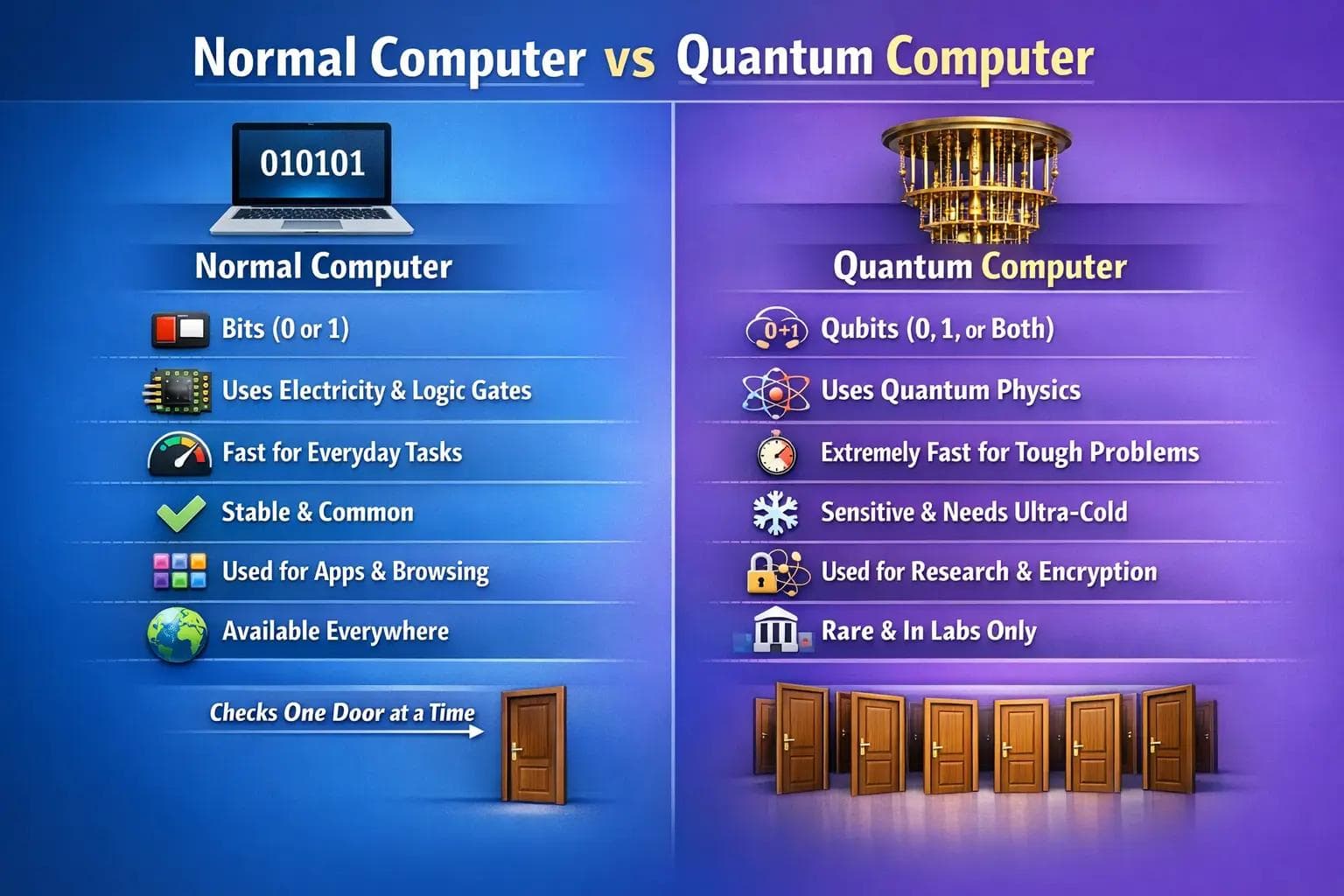
Normal Computer vs Quantum Computer – What’s the Real Difference?
What Is a Quantum Computer
We use computers every single day - for browsing, coding, designing, running businesses, and even building AI tools. But have you ever heard of a quantum computer and wondered how it’s different from a normal computer?
Let’s break it down in a simple way 👇
💻 What Is a Normal Computer?
A normal computer (like your laptop or smartphone) works using bits.
A bit can only be:
0 (off)
1 (on)
Every app, website, video, and software runs on millions and billions of these tiny 0s and 1s. Even powerful systems like supercomputers still follow this basic rule.
For example:
Browsing the internet
Running business software
Coding a website
Editing videos
All of this works perfectly with classical computers.
⚛️ What Is a Quantum Computer?
A quantum computer is completely different. Instead of bits, it uses qubits.
A qubit can be:
0
1
Both at the same time
Yes, that sounds crazy - but this is because of a quantum physics concept called superposition.
Big tech companies like IBM, Google, and Microsoft are actively building quantum computers to solve extremely complex problems.
🚀 Why Do We Need Quantum Computers?
Quantum computers are not meant to replace your laptop.
Instead, they are built for problems like:
Drug discovery
Climate modeling
Cryptography & security
Complex financial simulations
Advanced AI research
Some calculations that would take a normal computer thousands of years could take a quantum computer just minutes.
🤔 Will Quantum Computers Replace Normal Computers?
Not anytime soon.
Quantum computers:
Need extremely cold temperatures
Are very sensitive
Are still in research and development
For daily business tasks, website development, and apps — normal computers are more than enough.
💡 Final Thoughts
Think of it like this:
A normal computer is like a super-fast calculator.
A quantum computer is like a futuristic problem-solving machine built for the toughest challenges on Earth.
Both are powerful - just built for different purposes.